Lakebase
Recent items mentioning Lakebase across the Databricks ecosystem — releases, news, videos, and community Q&A. Updated hourly.
What is Lakebase?
Lakebase Postgres is a fully managed Postgres database built into the Databricks platform. It's real Postgres, so standard drivers and clients work, and instead of a fixed server you provision a project with branches and databases inside it.
Analytics tables in the lakehouse are a poor fit for application backends that need low latency reads and writes, and that's the gap Lakebase fills without leaving the platform. You can sync Unity Catalog tables into Lakebase so applications query them quickly, and store Postgres changes back as Delta tables for pipelines and audit (that direction is in Public Preview). Autoscaling, scale-to-zero, and instant branching keep development and test environments cheap to create.
Lakebase reached general availability on January 22, 2026, with automated backups and point-in-time recovery; read replicas and high availability with automatic failover are also available, the latter added in March 2026. As of September 2026 it tracks current Postgres releases, with major versions 16, 17, and 18 supported.
Is Lakebase generally available?
Yes. Lakebase reached GA on January 22, 2026, including autoscaling, scale-to-zero, instant branching, automated backups, and point-in-time recovery. One notable exception is storing Postgres changes as Delta tables with full change history, which is in Public Preview.
Is Lakebase real Postgres or just Postgres compatible?
It's actual managed Postgres, and standard Postgres drivers and clients work against it. As of September 2026 it supports Postgres major versions 16, 17, and 18.
How much does Lakebase cost?
Billing is usage based and began in January 2026, with snapshot storage billed separately since June 1, 2026. Scale-to-zero and autoscaling are the main levers for keeping idle branches and quiet databases cheap; Databricks publishes current rates per cloud and region on its pricing page.
Do I need Lakebase if I already have the lakehouse?
The lakehouse handles analytics, while Lakebase is for transactional application workloads that need low latency reads and writes. The two connect: you can sync Unity Catalog tables into Lakebase for fast serving, and capture Postgres changes back as Delta tables for downstream pipelines and audit.
Sources: Lakebase Postgres (Databricks docs) · Lakebase release notes (Databricks docs)
Lakebase is now the serving layer for real-time workloads: Spark Real-Time Mode feeds sensor data into it for a manufacturing digital twin 2, and streams market data into it to drive trading apps, ML models, and dashboards in energy trading 10. Lakebase Postgres also gained lakebase vector and lakebase text extensions for hybrid search, so agents get retrieval without an external database 5. Adoption signals are growing too: a Reddit thread describes migrating Europe from RDS Postgres to Lakebase 3, and a community post exposes the Lakebase Data API through Azure API Management 1.
Generated daily from the 10 most recent items mentioning Lakebase. Click any [N] to jump to the source.
Serving the Lakebase Data API Through Azure API Management
 News
Creating a Digital Twin with Spark Real-Time Mode and Lakebase
This video demonstrates how to create a real-time digital twin for a manufacturing cell using Databricks tools such as Spark Real-Time Mode, Lakebase, Databricks Apps, and Unity Catalog. It explains how processing sensor readings instantly allows operators to detect and act on equipment faults, such as a hot spindle, before they negatively impact production quality and efficiency.
Migrating Europe from RDS Postgres to Lakebase
submitted by /u/Limp-Park7849 [link] [comments]
How to teach with Databricks Free Edition
Databricks Free Edition can anchor a full data and AI curriculum, from intro data science and statistics through data engineering, BI, machine learning, AI, and capstone projects. Students work with the same tools used in industry, including Apache Spark, Delta Lake, MLflow, Lakebase, Genie, and Databricks Apps, while instructors can hand out assignments through an existing LMS or GitHub and share datasets via cloud storage, Open Sharing, or Marketplace.
 Tutorials
Lakebase Search: Build AI Retrieval for Agents with Lakebase Postgres
Lakebase Postgres introduces lakebase vector and lakebase text extensions to support hybrid search for AI agents. It leverages the Databricks Lakehouse architecture to synchronize and index data for efficient vector and full text search without requiring external databases.
The media industry is becoming a prediction economy
Media and advertising are shifting from counting attention to predicting and proving outcomes, which makes performance a leading indicator rather than a lagging one. Agents and measurement stall on fragmented data (only 3% of CMOs can tie half their marketing to a business outcome), so the post argues for one governed data and AI foundation built on context (CustomerLake, Genie, Lakebase), control, cost, and choice (Unity Gateway), and cites a pet specialty retailer that saw a 12% lift in transactions after activating loyalty data with agents.
How to add a resource to an app space?
Hi, I was testing out the Genie App Builder today and wanted to created an app which connects to a Lakebase postgres table. However, Genie told me the resource postgres is missing in the app (space) and I should add it. In the app settings I can't add the resource because the app is managed/restricted by the app space. But in the app space I cannot find the option to add the postgres resource either (according to the documentation only "User authorization", "Serverless usage policy", and "Permissions" can be configured https://learn.microsoft.com/en-us/azure/databricks/dev-tools/databricks-apps/app-spaces#configure ). Is it possible to add resources to app spaces? Or am I limited with them? submitted by /u/IIDraxII [link] [comments]
Test on a Branch, Not on Patients: Agentic Drug Substitution with Lakebase
AI Agent Memory
Databricks supports agent memory storage. The amazing part is that Lakebase stores the memory, so we can also inspect the saved record. We can save "User prefers Mexican recipes" and recall it through a client with the question "What should I cook for dinner?" more news https://medium.com/databrickscommunity/databricks-news-genie-cli-app-builder-agent-memory-dabs-41820427fcc2 submitted by /u/hubert-dudek [link] [comments]
Real-time energy trading and analytics on Databricks
Energy trading teams can run live trading and analytics on one Databricks platform instead of separate systems that leave risk data stale and governance duplicated. Spark Structured Streaming Real-Time Mode streams market data into Lakebase (serverless Postgres), which feeds the trading app, ML models, dashboards and Genie One, while Unity Catalog handles permissions, lineage and audit once for all of it.
Quest 4 Completed – Building and Deploying My First Databricks App with Lakebase
Databricks Apps/Jobs Deployment Issue on New Workspace: Due to Quota?
My company sells a data analytics application to professional sports teams. The application is built as a Databricks App, deployed into a customer's workspace. The underlying data model is seeded by ETL that lives in my own company's workspace, with the gold tables shared as pinned version views into the customer's workspace, where a daily job syncs the views into Lakebase on the customer side. I built this on Databricks partially because the customers typically don't have robust IT teams in-house. Rather than requiring them to self-manage a bunch of infrastructure or host my own costly SaaS backend, I figured I could save a lot of complexity by setting up a Databricks workspace for them and deploying the application code into it via DAB from a central repo. I'm having an issue with a new customer that I onboarded yesterday. They created a new Azure subscription for the purpose of deploying the Databricks workspace + our application. Everything deployed successfully, but the Databricks App stops itself after approximately two hours. At first I thought it was a transient issue and restarted the app, but it keeps recurring. Troubleshooting has been challenging, because App logs are not visible when an App is stopped. I was able to get the following from the CLI ( databricks apps get -o json ): "app_status": { "message": "App status is unavailable.", "state": "UNAVAILABLE" }, "compute_size": "MEDIUM", "compute_status": { "message": "App compute was stopped due to workspace or account status.", "state": "STOPPED" }, Both the Azure subscription (Azure Plan) and the Databricks workspace (Premium + RBAC) do not appear to be in a trial state. Both were set up in the past 48 hours. I suspect this is some kind of new workspace restriction on the Databricks side, but I'm not sure what can be done about it. The App is deployed into a few different workspaces and runs without issue, but all of the workspaces have existed for a while. This is the first Workspace that was deployed specifically for the App. I found this thread on Databricks Community that describes a similar issue, but it appears to have died without a resolution. Has anyone run into a similar issue, and is there anything that can be done about this? It's likely that many of our customers will need a new Databricks workspace to deploy our application, so if this is a recurring issue, we may need to rethink our entire architecture. submitted by /u/Minute_Visual_3423 [link] [comments]
The Fraud Analyst AI Coworker: Detecting Telecom Fraud in Real-Time on One Platform
Databricks Lakebase, Databricks Apps, and Genie combine into a single fraud detection stack for telecom, with Lakebase removing the analytical/transactional split for faster data sync, Apps powering a custom case-management workbench, and Genie acting as an AI coworker that answers natural-language questions over governed fraud data. The post argues that real-time network telemetry strengthens fraud models as attackers use agentic AI at machine speed, and the Telecom Fraud Prevention Solution Accelerator deploys the risk engine, workbench, and investigation agent via Databricks Asset Bundles, adaptable to other industries.
LTAP without lakebase?
Is there any world where an LTAP architecture can be created that does NOT include lakebase, or databricks for that matter? It seems to me that it isn't much more than a marketing term for selling lakebase. Every public doc about LTAP has references to lakebase sprinkled all over it. Lakebase is mentioned from the beginning to the very end. As I understand LTAP is essentially defined as a shared storage layer for OLTP and analytics workloads. And that sort of storage is an implementation detail that is ONLY found in the deepest and most proprietary parts of lakebase. (IMO, Microsoft has had their own flavor of LTAP for many years, in the form of Fabric DW. That engine looks and acts similar to a TSQL database, yet emits lakehouse files in storage. Yet I suppose it lacks some very particular features, or performs badly on certain disqualifying OLTP workloads. The disqualifications will always allow a databricks salesman to refuse to call it LTAP. If these disqualifications aren't purely subjective, then maybe we also need to define LTAP in terms of a certain TPS threshold and a certain set of minimal DBMS capabilities. I haven't seen anything like that.) submitted by /u/SmallAd3697 [link] [comments]
Performance Test - Batch-Loaded Unique Constraint Validation in Lakebase
The vendors that create big-data engines keep saying it is so challenging and costly to enforce uniqueness constraints in their managed catalogs (eg. in technologies like UC managed tables, that live on top of lakehouse blobs). They say it "doesn't scale". And that it gets more challenging at large volumes. But this is like anything else - customers should still be empowered to use features that may not always scale well. Would this problem get easier if they offered it only for certain data types like 32 bit unsigned integers? Lets consider Lakebase. Lets say I'm a user of Lakebase, and I'm running sequential batch transactions to insert a consecutive series of 1000 integers at a time that are validated by the database to be unique. How long would it take until those transactions to become slower than 100ms? Should I expect to to insert all 4 billion integers and never see any transaction take longer than 100ms? Now lets do a similar thing in a UC managed table , where we insert the same sequentially increasing 1000 integers at a time, and I check for the uniqueness of these myself in my serializable insert transactions. (Because the UC managed table won't help me with that.) Obviously my uniqueness validations would start to slow down over time. As I approach the limit of 4 billion integers I would expect the insert operations to take longer than lakebase , but possibly never more than one second per transaction. Does that sound about right? (If necessary I might use cheats, like break apart the integer into four columns of one byte each, then use partitioning). TLDR, validating uniqueness with 32 bit integers may be harder in a UC managed-table than for lakebase. But IMO that does NOT mean customers should be doing the heavy lifting ourselves. These lakehouse-based technologies should give us a mechanism for it, even if there are restrictions (ie. certain data types, tables of no more than 4 billion rows, etc). submitted by /u/SmallAd3697 [link] [comments]
Lakebase: Postgres That Actually Likes Your Lakehouse
Introducing Agent Memory on Databricks
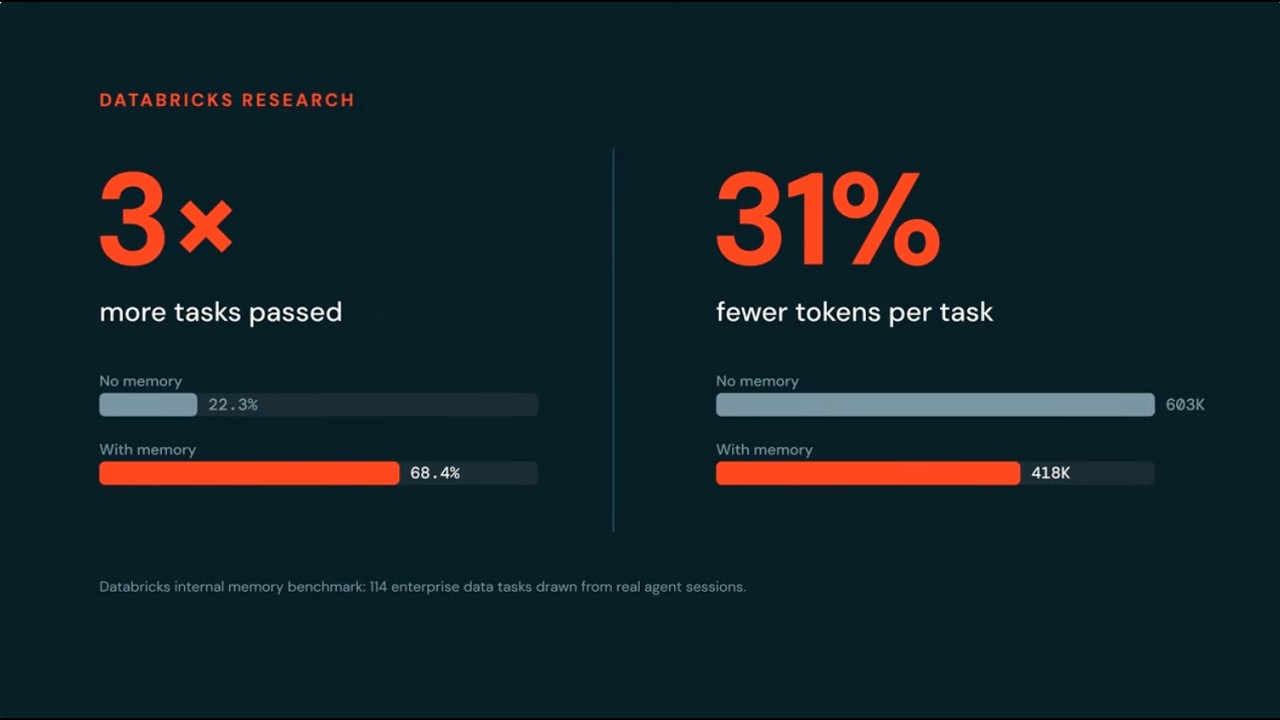
Agent Memory is now in Beta on Agent Bricks, giving agents a Lakebase-backed store for facts, preferences, and workflows, built on Databricks Research's MemCurrent architecture, which combines plugins, on-demand tools, and an offline "dreaming" pipeline. In Databricks' internal benchmarks on enterprise tasks, it tripled agent pass rate while using 31% fewer tokens, and the Agent Bricks CLI can deploy an agent with memory and sessions in minutes.
How Hamlet uses Databricks Lakebase Postgres to test changes against production data
Hamlet gives every pull request its own Lakebase Postgres branch of production data, so engineers can reproduce and test fixes against the exact data that caused a bug without touching production. AI coding agents run the pipelines and check their work on each branch before a person approves the merge, and Hamlet is now exploring Lakebase Search, branching for object storage, and a home for longer agentic jobs.
 Releases
Introducing Agent Memory on Databricks
Databricks announced Agent Memory, a new tool for Agent Bricks that allows AI agents to store and recall past conversations and user data using lakebase architecture. By connecting session stores and memory stores through automated memory pipelines, agents can retain context across multiple sessions to improve task performance and reduce token usage.
How to Sync Lakebase Tables to Delta with Lakehouse Sync
 Tutorials
Building Production-Ready AI Agents on Databricks | Agent Bricks Demo
Building production ready AI agents on Databricks involves a six step workflow spanning vector search indexing, agent as code, MLflow tracing, Unity Catalog registration, evaluation, and deployment with review apps. MLflow tracing and evaluation metrics help monitor agent execution steps, relevance, safety, and topic adherence in real time.
 News
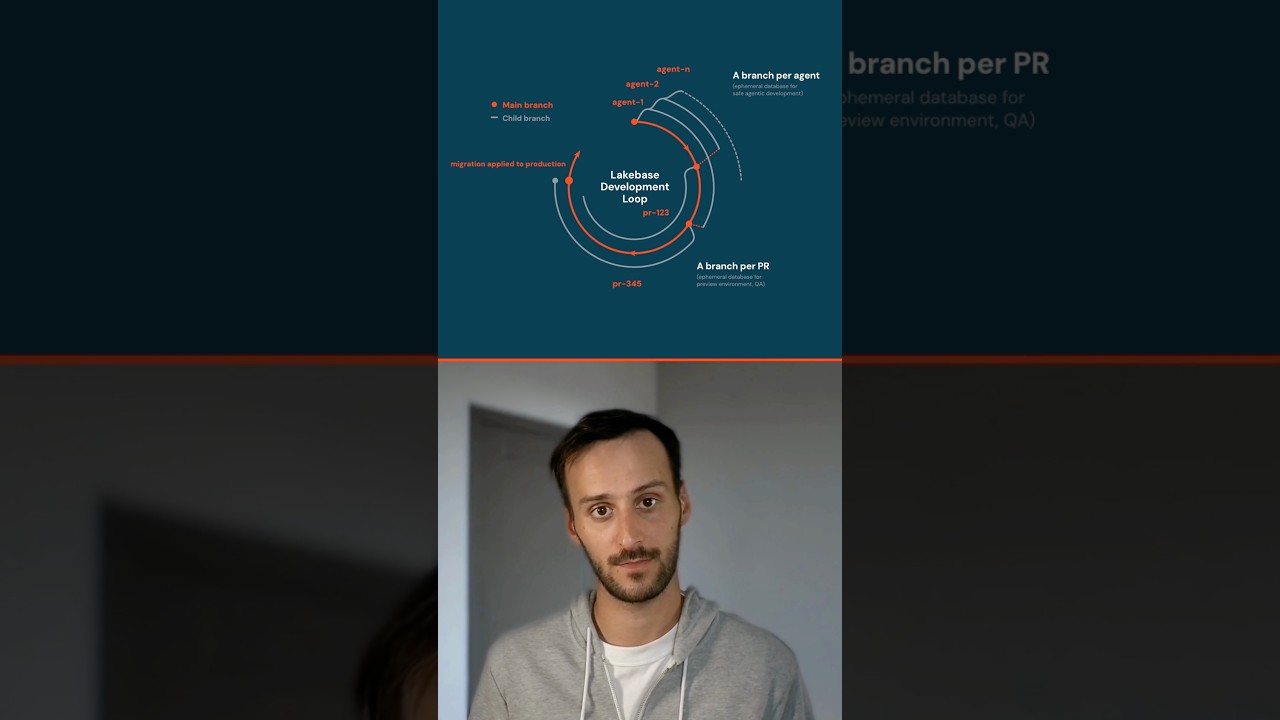
Shorts extracted from Parallel Coding Agents with Lakebase
Coding agents can use git worktrees and branch databases to work safely in parallel. This allows multiple agents to test features against isolated database branches without interfering with production or each other.
Participate in a Lakebase user study!
👋 Hi r/databricks , I'm Connie from the Databricks UX team! The Databricks Platform team is conducting a usability evaluation to understand how Lakebase users set up, configure, and debug LTAP (Lake Transactional/Analytical Processing). We are hoping to connect with individuals using Lakebase on data and app development teams . Study details are as follows: Topic: Lakebase LTAP usability Duration: 60-min remote session over Google Meet Study date(s): October-November, 2026 (rolling) Compensation: $25 USD " thank you " gift card for the study session, if your company policy permits. Please fill out the screener survey if you’re open to participating in a 60-min call in the upcoming weeks, or can connect me with a member of your team who may be the right fit. Completing this screener survey does not guarantee eligibility into the study. The UX team will be reviewing responses for inclusion. Thank you for taking the time to help us build a better product! submitted by /u/Logical-Novel4483 [link] [comments]
How do you manage, in a Databricks Asset Bundles-based CI/CD, the permissions and access resources that a bundle cannot declare?
We have a DABs-based CI/CD in a monorepo and want to split it: deploy the DABs from the data-code repo and keep the Terraform infrastructure in a separate repo. The original idea was that Terraform would change at a different pace and its deployments would be manual, with no automated dependency on DABs deploys. However, at work they’re now saying this infrastructure part should be tied to the DABs deployment and not be manual, and I’m unsure where it should live and how to automate it. We mainly run into four cases: Cross-boundary grants: our pipeline needs to read a table owned by another team, so we need to grant SELECT on that table/schema to our service principal. Postgres grants: a job needs to connect to a Lakebase database and requires a GRANT on a Postgres schema, table, or role. Share contents: we need to add or remove tables and views from a Delta Sharing share consumed by an external consumer. Notification destinations: a job or pipeline needs to send alerts to a notification destination (email, Slack, webhook) that the bundle cannot declare. Today, all of these live in Terraform outside the bundle, so every time the data code needs one of these changes, we have to coordinate a separate MR and deployment in addition to the bundle deploy. Where do you put these in your pipeline: inside the bundle, in a separate Terraform stack applied after the bundle deploy, in the platform repo, or another way? What issues have you run into with each approach? Tx so much submitted by /u/Appropriate_Tip_9580 [link] [comments]
Announcement | Stripe Data Pipeline now syncs real-time Stripe data to Lakebase Postgres
Lakebase Search: Vector, Keyword, and Hybrid Retrieval Inside Databricks Postgres
Lakebase - OLTP Workloads on Databricks!
IoT device + Databricks Free Edition
tried out Free Edition for first time this year, it is surprisingly capable. Apps, Lakebase, Serverless Jobs, ML Flow, Genie worked well without any issues. created a demo with sending real IoT data to workspace. https://youtu.be/_RcoBxriu9Q submitted by /u/ramgoli_io [link] [comments]
Stripe Data Pipeline now syncs real-time Stripe data to Lakebase Postgres
Stripe Data Pipeline now streams real-time Stripe data directly into Databricks Lakebase Postgres with no code required, eliminating the need to build and maintain custom API or webhook integrations. Applications can now query always-current Stripe data using simple SQL to gate features, display live billing details, and trigger personalized offers.
Sizing Lakebase Search: lessons from a real app and 4 million passages
Sizing the Local File Cache to match the vector index keeps up to 98% of pages in memory and drops warm vector latency to single-digit milliseconds directly inside Lakebase Postgres. Reducing the search candidate pool to 200 cuts page reads by two-thirds while preserving 90.5% of top-10 results, with an always-on 0.5 CU floor providing an optimal production baseline for just $31 to $40 per month.
 Tutorials
Run Live Energy Trading, Risk, and Analytics in Databricks
Databricks enables real-time energy trading and risk management by combining Spark Real-Time Mode and Lakebase for unified operational and analytical data processing. The platform provides a single source of truth with Unity Catalog governance, streamlining trading desks, price forecasting, and reporting within one environment.
Lakebase CDF to Unity Catalog vs firewall on storage
I have a use case where Lakebase CDF (transparent syncing of tables from PostgreSQL to Unity Catalog) would be super convenient. However I found that currently the CDF doesn't support storage accounts behind a firewall, accessible through a private endpoint, etc. They have to be publicly accessible, which is a no-no for most corporate data. Can anyone from DataBricks share whether it's on your roadmap to add support for this and when? submitted by /u/djfeelx [link] [comments]
Lakebase - Part 2
Announcement | Lakebase and Agentic SDLC: Branching Databases for Coding Agents
 News
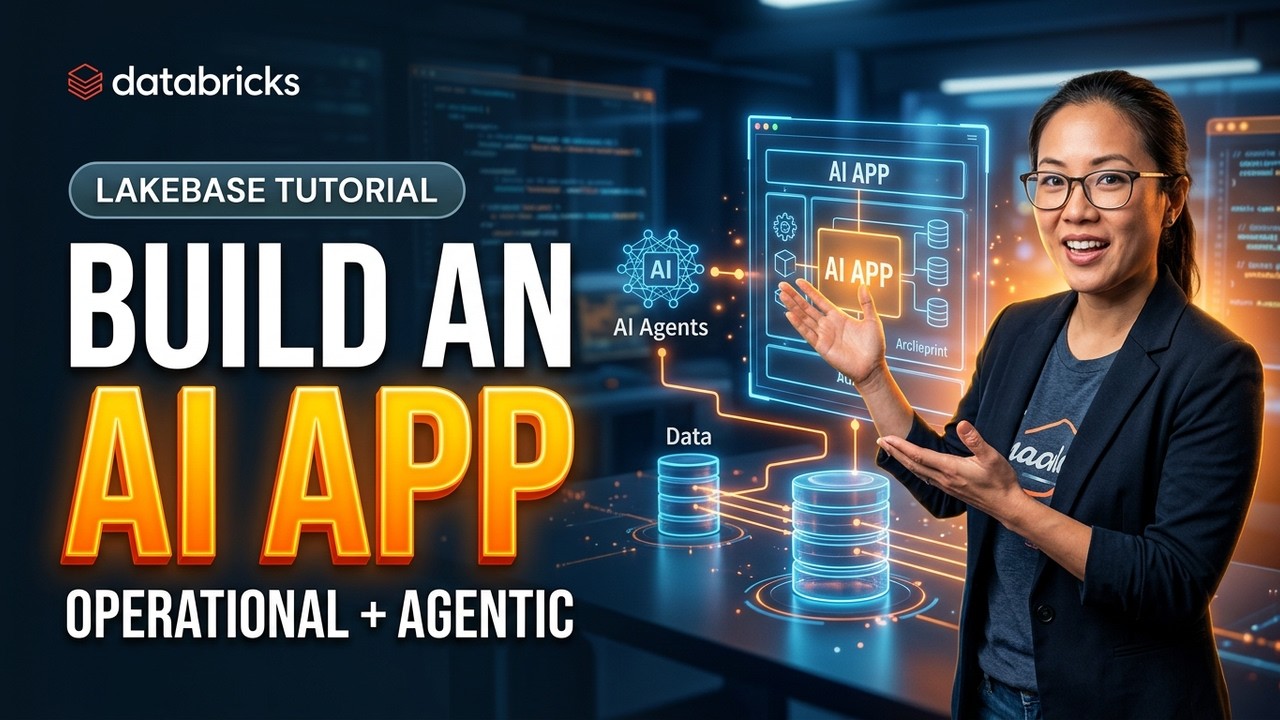
Building on Lakebase | Episode 2: Anatomy of an AI app: build the operational + agentic app
This video demonstrates the architecture and deployment of a customer support AI co-pilot built as a Databrics app backed by Lakebase. It walks through configuring a transactional operational store, hybrid search, managed agent memory, and MLflow tracing to power an interactive agentic application.
Announcement | Load terabytes of data in minutes into Lakebase Postgres
Building an Expense Management App with the Genie App Builder Leveraging Lakebase + AI for Image Scanning
I previously did not consider Databricks a great place to build apps on with AI. With the release of Genie App Builder (still in beta), that has changed, and now I see it as a serious player in the AI app building space. Before I start, quick disclaimer: I am part of the Databricks MVPs, work for a consulting company that is a Databricks partner, etc. That said, this review is fully based on my experience, my own words, my own testing, etc. Always try things out yourself! Things I appreciated: +By far, this feels like the most polished Databricks beta that has been released. If the goal is to make this easy for business users to develop applications easily and securely, this feels like it is already there. Granted, I have not tested with multi-users yet, but it feels very polished already. +Native integration with Databricks features like Lakebase. +Even though it has native integrations to Databricks features, it didn't force these features in building what I did when it was otherwise unnecessary. For example, the dashboard it built as part of the application was not an AI/BI Dashboard. I would have expected it do that, but it didn't, and rightfully so, as it would not have been truly the best thing for this use case, so truly a customer first thing here. +Respects governances/access controls, meaning I can develop an application freely in the sandbox environment, but if I want to deploy it, organizational safeguards, Unity Catalog, and other controls built on Databricks apply. Things that could be better: -With the goal of empowering citizen devs (or i should just say, business users that are technical enough), there needs to be an easier way to send request for access/capability etc to admins. Right now, the builder tells you through the chat, but that is not as intuitive as having a clear UI-embedded to-do things before deploying etc. One step further would be that the developer can notify the administrator of this need. -I found that when I developed an application that had to use a sandbox only capability when access was otherwise unavailable (see above), just hung when I tried to reopen the dev experience for it. I had to troubleshoot through the chat interface as to why that was happening to figure this out. Additional Note : Currently free at the moment, but pricing is not yet available since we are in beta. Will be interesting to see how the overall value of this capabilities plays out factoring the ease & governance vs compute & token costs. Closing Thoughts I think this is on track to be one of Databricks' best released feature, and a serious entry in the space that is otherwise feel with undifferentiated app building solutions. Is it creating a new category? No. But it feels like an Apple-level product, where being the best at executing is sometimes better than being the first to do something. And I believe it will pay off as businesses look more carefully as to where they spend their hard-earned money on. From a "data + AI platform vendor" perspective, this is currently the best offering of its kind. From an "app building vendor" perspective, there are still solid players out there, but for enterprise focused apps, in the top 3 of options I would consider, and for sure the first one I would try if my stack was heavily Databricks focused. submitted by /u/JosueBogran [link] [comments]
Things I miss on Databricks
Here are a couple of things I miss on Databricks: Group jobs per category. We all know that jobs can become messy sometimes. Connect jobs in Git more easily Data Quality. Like for real, where users can establish rules, create scans, quarantine, break pipelines, and etc. I don’t want to take my data outside to do it. App Genie Builder that won’t force me going to bundle Scale to zero apps without needing to use App Genie Builder Similar to 1, grouping queries, we all know that it can get messy with time Auto TTL in Lakebase (don’t know if it’s possible, but that’s a very good functionality) What else do you miss in Databricks? submitted by /u/Select_Morning8221 [link] [comments]
Databricks Acquires Responsive
Responsive is joining Databricks to accelerate development of Lakebase. submitted by /u/sai-nageshwaran [link] [comments]
Building on Lakebase | Episode 1: Meet Lakebase
 News
Agent Bricks: The Agent Developer Platform | Overview
Databricks introduces Agent Bricks, a developer platform that provides infrastructure components for building, deploying, and scaling AI agents. The platform features flexible hosting, a unified API for model routing, secure sandboxes, managed memory, and tools for real-time tracing and evaluation.
I thought Databricks Lakebase was expensive
I used to think Databricks Lakebase was pretty expensive. A few Databricks architects I've talked to thought the same, especially when you factor in syncing data between Lakebase and Lakehouse. With LTAP coming, that second part should become less of an issue. Recently, we were adding Lakebase pricing to our free FinOpsWay extension so you can see estimated costs directly in the Databricks UI when creating a database. And I was honestly surprised by the numbers. Compute was cheaper than I expected, especially with scale-to-zero. Obviously, it depends on the workload, but I think I dismissed Lakebase too quickly without actually looking at the pricing. Anyone running Lakebase in production? Curious how much you're actually spending and whether it's worth it. submitted by /u/Significant-Guest-14 [link] [comments]
 News
How HelloFresh Optimizes 100% of Meta Ad Spend With Genie Agents on Databricks
HelloFresh uses Databricks Genie agents and Unity Catalog to optimize 100 percent of its Meta advertising spend and break down internal data silos. This data infrastructure reduces weekly maintenance and reconciliation hours significantly while accelerating ad testing and campaign launches.
When (if at all) does Databricks plan to have bidirectional sync between Lakebase and Lakehouse?
I’m working on a project that could really benefit from bidirectionally syncing table entries that come in through an application hitting Lakebase as well as those batched into the Lakehouse from an external API. Do we know when bidirectional sync is expected? submitted by /u/ceeej777 [link] [comments]
Lakebase and Agentic SDLC: Branching Databases for Coding Agents
Lakebase resolves the database bottleneck for parallel coding agents by providing sub-second, scale-to-zero copy-on-write database branching for each agent. Learn how to implement an end-to-end workflow pairing Claude Code, Git worktrees, and GitHub Actions to run Drizzle migrations, deploy preview environments on Databricks Apps, and test against Unity Catalog-masked data.
Load terabytes of data in minutes into Lakebase Postgres
Lakebase Postgres leverages an LTAP architecture to offload bulk loading to Spark, building pages and indexes in parallel to load terabytes of data up to 147x faster. By writing directly to storage and publishing the final manifest through a compact WAL record, the system avoids consuming live application resources and keeps OLTP queries unaffected.
How to build governed enterprise apps on Databricks with Replit and Lakebase
Combining Replit and Databricks provides enterprises with a complete development-to-deployment platform for building governed applications. Learn how to leverage Replit alongside Lakebase to construct and deploy governed enterprise apps directly on Databricks.
 News
Building on Lakebase | Episode 1: Meet Lakebase
Lakebase is a fully managed serverless PostgreSQL database from Databricks that disaggregates storage and compute for variable AI and operational workloads. The video demonstrates provisioning a Lakebase project, creating operational tables, and syncing curated Lakehouse data to build the foundation for an agentic support co-pilot.
Announcement | Lakebase Search: State-of-the-art full-text and vector search for Postgres
Group-based auth with Lakebase Data API
Lakebase CDF/WAL2Delta cannot write to UC managed storage with Private Endpoin
Built a live Helsinki tram tracker on Databricks with Lakeflow, Lakebase, Genie and Apps
Real-Time Retail Intelligence: Building E-Commerce Recommendations with Lakebase and AI Search on Databricks
A complete reference architecture is now available for building a real-time, multi-stage e-commerce recommendation engine on Databricks using AI Search for candidate retrieval, Lakebase for online feature serving, and Model Serving for low-latency inference. By unifying batch precomputation and real-time scoring on a single governed platform, this design replaces fragmented ML stacks to eliminate glue code and deliver end-to-end lineage from raw clickstream to production predictions.
Lakebase Postgres branch-based restores for fast recovery at scale
Lakebase Postgres introduces branch-based restores, a metadata operation that instantly recovers databases by pointing to immutable history in decoupled storage rather than copying data. This capability cuts recovery times for 100 TB databases down to seconds, eliminating prolonged downtime and enabling seamless branching and undo workflows for AI agents.
 News
Parallel Coding Agents with Lakebase | Claude Code + GitHub Actions
This video demonstrates how to run multiple coding agents in parallel by combining git worktrees, GitHub Actions, and Lakebase database branching. It shows how each agent automatically receives an isolated database branch for safe experimentation and schema migrations, followed by dedicated preview environments for pull requests.
 News
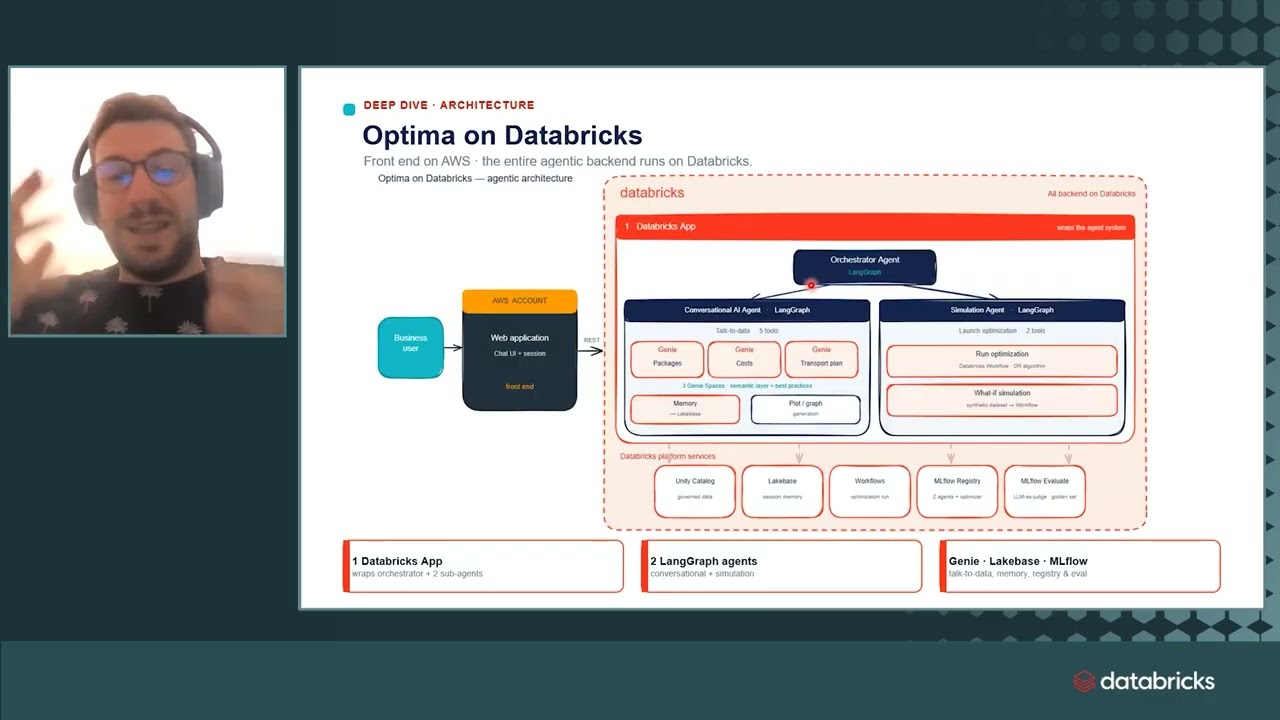
How ModMed Transforms Healthcare AI and Agentic Workflows with Databricks
ModMed uses the Databricks Lakehouse platform and Unity Catalog to build secure AI-enabled healthcare applications and agentic workflows. The integration of these tools allows both technical and non-technical users to access near real-time data insights and solve complex problems efficiently.
A practical guide to cost optimization with Lakebase Postgres
Lakebase Postgres delivers low, predictable costs when you sync only the working subset of Lakehouse data, match sync modes to actual freshness needs, and right-size compute so hot data fits in cache. Combining these optimization practices with serverless scale-to-zero, tuned PITR, and shared storage ensures strong performance and availability without paying for unused resources.
Databricks Lakebase Search - GA Announcements
submitted by /u/Wise_Ear_4064 [link] [comments]